Thought for the day – Thursday 4 June

Thought for the day - Thursday 4 June
Dear All
Whenever we are able to, it will be nice to plan a holiday abroad once again and look forward to it in anticipation. We can of course, look forward, but we can’t, as yet, make any definite plans. I mention ‘abroad’ today not because holidays overseas are always better than holidaying here at home but because it’s the different languages I want to talk about, those we hear abroad.
Some of you might know already, but for those of you who don’t, I am learning German. (Ich lerne Deutsch). I have a fascination with words and languages but that of course, does not mean that I have any particular skill or talent for such. We all know that practice does make perfect. I will continue to practise, I will need to if I’ve any chance of fulfilling a challenge. I’m ‘expected’ to be able preach an entire sermon in German. When that will be and how long that sermon will take is anybody’s guess. ‘Ich ube mein Deutsch jeden Tag’.
You will have noticed broad similarities in some languages, like French, German, Italian, Spanish and English for example, as they have a common Latin root. When you consider Chinese, Japanese, Russian and other Slavic languages however, it’s not so easy. These languages are nothing like our own. They use different characters and letters. The Cyrillic alphabet is used in places like Russia Bulgaria, and the Czech Republic and in China and Japan a sophisticated system called Hanzi and Kanji, both to me indistinguishable, but they are in fact quite different.
Even our own word ‘English’ is something of a mixture. The English language contains many French and German words and is understood to be from the word ‘Anglish’ derived from the German, Angles and Saxons. All of this though, may be of no real Interest to you, even if it is to me so I won’t go on much further in case I bore you completely, and instead turn to our bible passage which is about the ‘origin’ of different languages used around the globe.
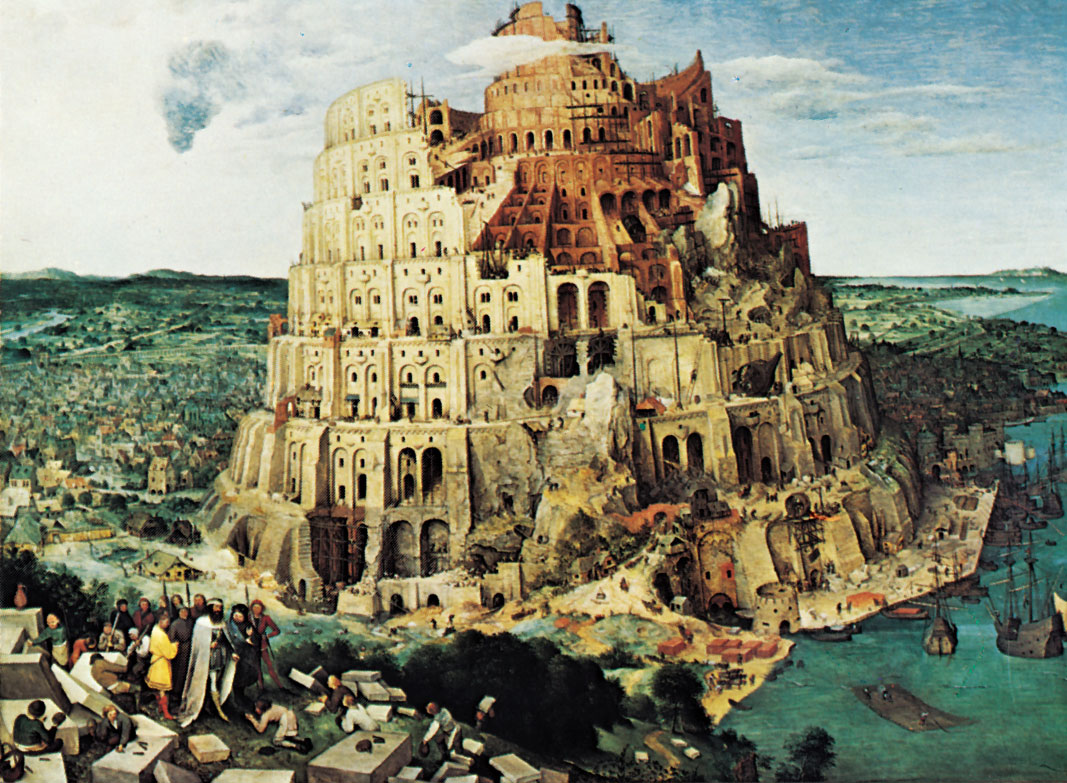
Immediately as you read this passage you run into ‘problems’. Problems that is, if the story is taken as actual, factual and historical. ‘The Tower of Babel’ is surely a story with a meaning and moral and should, I believe, be treated as such. Others may differ.
In the story it would seem that there is some enmity or at least competition between the heavenly beings and their earthbound counterparts who are reaching for the sky. Perhaps ‘pride’ is the lesson?
Commentaries on this passage will differ significantly depending on one’s theological persuasion. It is possible to let the story speak to us as a lesson, or bring to the passage our own existing world view and try to make it say what we want it to. A few days ago I mentioned two significant ‘theological’ words that make the point, those of, ‘exegesis’ or ‘eisegesis’.
Whoever you are or wherever you come from we all know something of ‘body language’. A smile or a frown are the same the world over, it’s the same with laughter or crying too, they are all ‘spoken’ and clearly understood.
I would like you to consider also what Paul writes in Corinthians 13. Paul is here speaking about a different language. Whatever one’s colour, creed, or nationality there is a language that everyone can understand and ‘speak’ and that is the language of love. God is love.
What is the building of the Tower of Babel all about, what do you take the lesson to mean, and is there something for us all to learn about each other and God?
Today I ask you to think/meditate on these things.
God bless you!
Jim
JBoag@churchofscotland.org.ukGENESIS 11: 1-9

Now the whole world had one language and a common speech. As people moved eastward, they found a plain in Shinar and settled there.

They said to each other, “Come, let’s make bricks and bake them thoroughly.” They used brick instead of stone, and tar for mortar. Then they said, “Come, let us build ourselves a city, with a tower that reaches to the heavens, so that we may make a name for ourselves; otherwise we will be scattered over the face of the whole earth.”

But the Lord came down to see the city and the tower the people were building. The Lord said, “If as one people speaking the same language they have begun to do this, then nothing they plan to do will be impossible for them. Come, let us go down and confuse their language so they will not understand each other.”

So the Lord scattered them from there over all the earth, and they stopped building the city. That is why it was called Babel—because there the Lord confused the language of the whole world. From there the Lord scattered them over the face of the whole earth.

share

Leave a Reply

Your email address will not be published. Required fields are marked *