

Thought for the day – Monday 8 June

Dear All
Animals, in just about every culture we can think of are often depicted with certain characteristics, traits and qualities, eg the wise owl, the brave lion, the sly fox and the stupid ass. We find many examples of these anthropomorphisms in our children’s stories and folklore, all of which are memorable, entertaining and sometimes have a valuable lesson to teach us too, such as Aesop’s fables.
In our common speech we often use similes to the same effect do we not? We can often be heard to use expressions such as, ‘the boy eats like a horse, he is as strong as an ox, and the girl is as beautiful and elegant as a swan’ for example. In our conversations every day we use simile, metaphor and anthropomorphisms without thinking about it, except of course, if you’re about to sit an English exam.
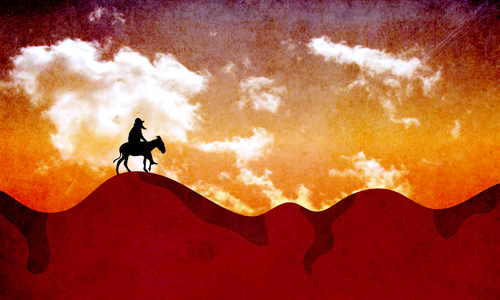
The tale of Balaam and his donkey is contained in the book of Numbers and is part of the Torah, the first five books of what we call the Old Testament and it has a valuable lesson to teach us. It is first and foremost a Jewish tale set against the background of the relationship between the Israelites and their neighbouring Moabites.
The Israelites unlike many of their neighbouring tribes were forbidden to practice divination, incantations and sorcery for example, and were not to engage in certain rituals and practices. No graven images were to be worshipped or revered as YHWH was their God and he alone was to be worshipped. ‘You shall have no other gods before me, for I the Lord your God am a jealous God’. The Hebrews were strictly monotheistic as opposed to their pantheistic ‘neighbours’.
Balaam was engaged in some kind of treacherous act against his own people, an act of betrayal that involved some form of curse on them the Israelites. As he was on his way, riding his donkey to meet some officials, an angel of the Lord appeared before him and sought to turn him back. This happened three times but on each occasion, it’s the donkey who sees the angel and attempts the body swerve. Each time the donkey does this it is beaten.
What Balaam fails to realise is that it is the Lord himself he is ‘beating’, Balaam just doesn’t seem to see that what he is doing is against God and his own folk. In all of this though, God still allows him to do want he wants and God ultimately does not ‘stand in his way’.
Each of us every day faces choices of one kind or another, many are no more important than what to wear, how we will fill our time, or what to eat, for example, other decisions, however, are more serious and important and require much more thought and consideration of the more serious, possible outcomes and consequences.
Balaam had decided on what he was going to do, ie to meet and collude with the Moabites. Three times God attempted to get him to change his mind but he wouldn’t. This, I think, should be understood to be more by persuasion than by force as Balaam eventually does his own thing. It is the donkey that sees what Balaam doesn’t and wants to turn and go back. Balaam fails to heed the ‘warnings’.
We know right from wrong based on our upbringing and moral and religious teaching, sometimes we have to be told and reminded, however. God does not force us to do what we don’t want to do. We have free will. If we choose to go our own way and be like Balaam, God will honour that decision but the consequences will be ours.
What has this passage to teach us about free will and consequences?
Today I ask you to think/meditate on these things.
God bless you!
Jim
NUMBERS 22: 21-39
Balaam got up in the morning, saddled his donkey and went with the Moabite officials. But God was very angry when he went, and the angel of the Lord stood in the road to oppose him. Balaam was riding on his donkey, and his two servants were with him. When the donkey saw the angel of the Lord standing in the road with a drawn sword in his hand, it turned off the road into a field. Balaam beat it to get it back on the road.
Then the angel of the Lord stood in a narrow path through the vineyards, with walls on both sides. When the donkey saw the angel of the Lord, it pressed close to the wall, crushing Balaam’s foot against it. So he beat the donkey again.
Then the angel of the Lord moved on ahead and stood in a narrow place where there was no room to turn, either to the right or to the left. When the donkey saw the angel of the Lord, it lay down under Balaam, and he was angry and beat it with his staff. Then the Lord opened the donkey’s mouth, and it said to Balaam, “What have I done to you to make you beat me these three times?”
Balaam answered the donkey, “You have made a fool of me! If only I had a sword in my hand, I would kill you right now.”
The donkey said to Balaam, “Am I not your own donkey, which you have always ridden, to this day? Have I been in the habit of doing this to you?”
“No,” he said.
Then the Lord opened Balaam’s eyes, and he saw the angel of the Lord standing in the road with his sword drawn. So he bowed low and fell facedown.
The angel of the Lord asked him, “Why have you beaten your donkey these three times? I have come here to oppose you because your path is a reckless one before me. The donkey saw me and turned away from me these three times. If it had not turned away, I would certainly have killed you by now, but I would have spared it.”
Balaam said to the angel of the Lord, “I have sinned. I did not realize you were standing in the road to oppose me. Now if you are displeased, I will go back.”
The angel of the Lord said to Balaam, “Go with the men, but speak only what I tell you.” So Balaam went with Balak’s officials.
When Balak heard that Balaam was coming, he went out to meet him at the Moabite town on the Arnon border, at the edge of his territory. Balak said to Balaam, “Did I not send you an urgent summons? Why didn’t you come to me? Am I really not able to reward you?”
“Well, I have come to you now,” Balaam replied. “But I can’t say whatever I please. I must speak only what God puts in my mouth.”
Then Balaam went with Balak to Kiriath Huzoth.
Recommended Posts
Thought for the day – Sunday 21 June
June 21, 2020

Thought for the day – Saturday 20 June
June 20, 2020
Thought for the day – Wednesday 17 June
June 17, 2020